
Playtest Feedback Questions That Actually Help
Ask about what players felt and did, not what they'd fix. Five questions that work for almost any game, questions about moments, and when to ask them.
· 3 min read
In this post
"What did you think?" gets you "It was fun!" and a polite smile. The questions you ask after a playtest decide whether you learn anything, and the best ones are about what players felt and did, not what they'd fix.
Ask about the experience, not the solution
Players are excellent at noticing when something feels wrong and unreliable at diagnosing why. "Make the dragon cost 5" is a guess; "I never felt I could afford the dragon" is evidence. Ask for the second kind and do the diagnosing yourself.
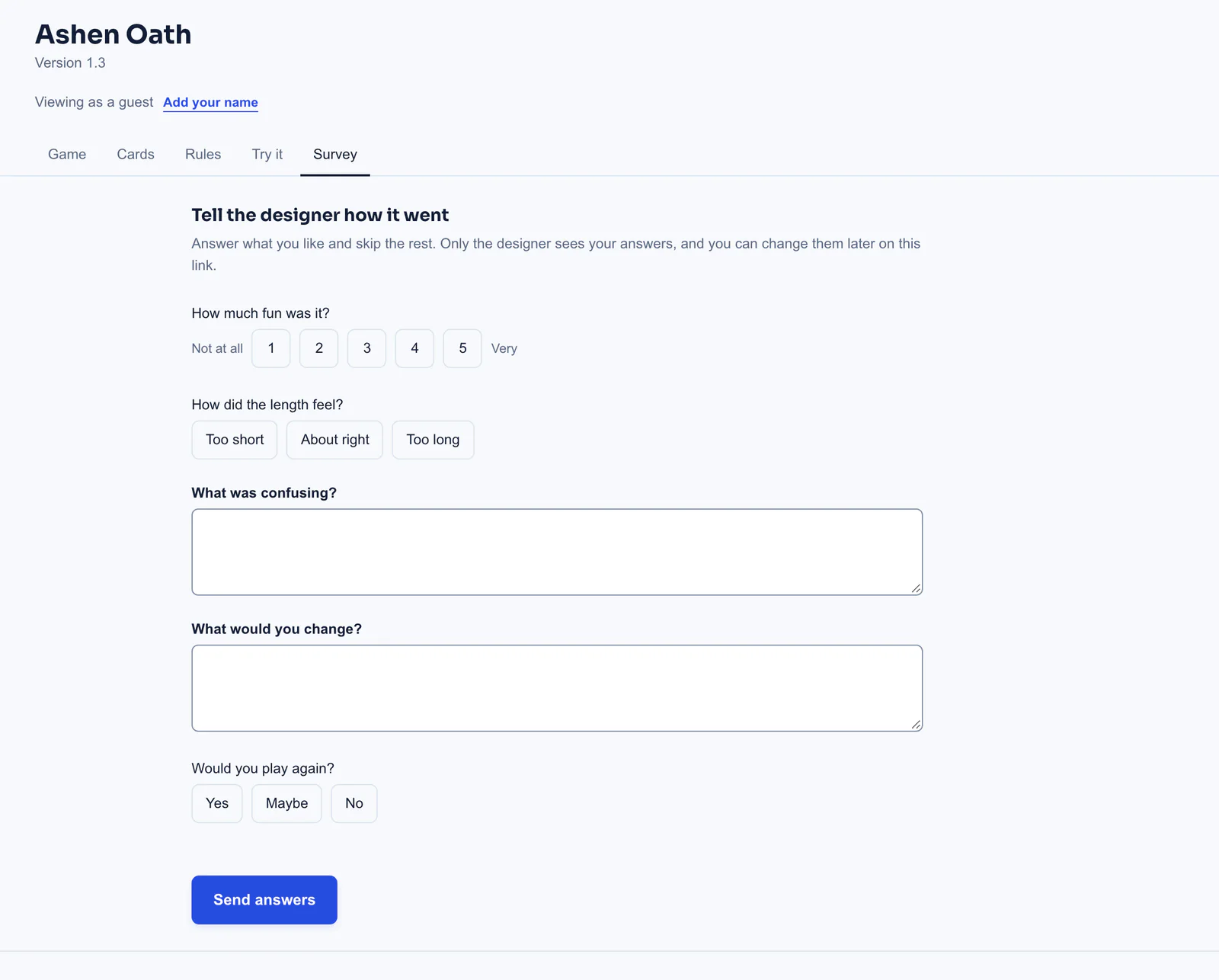
So ask:
- How much fun was it? On a scale of 1 to 5. A number is easy to answer honestly, and easy to compare across sessions and versions.
- How did the length feel? Too short, about right or too long. Players rarely know the clock time, but they know whether they wanted it to end.
- What was confusing? The single most useful question. Every answer points at a rule, a card or a turn.
- What would you change? Asked last, so it doesn't steer the others. Read the answers for the problem behind the suggestion.
- Would you play again? Yes, maybe or no. The truest measure of fun there is.
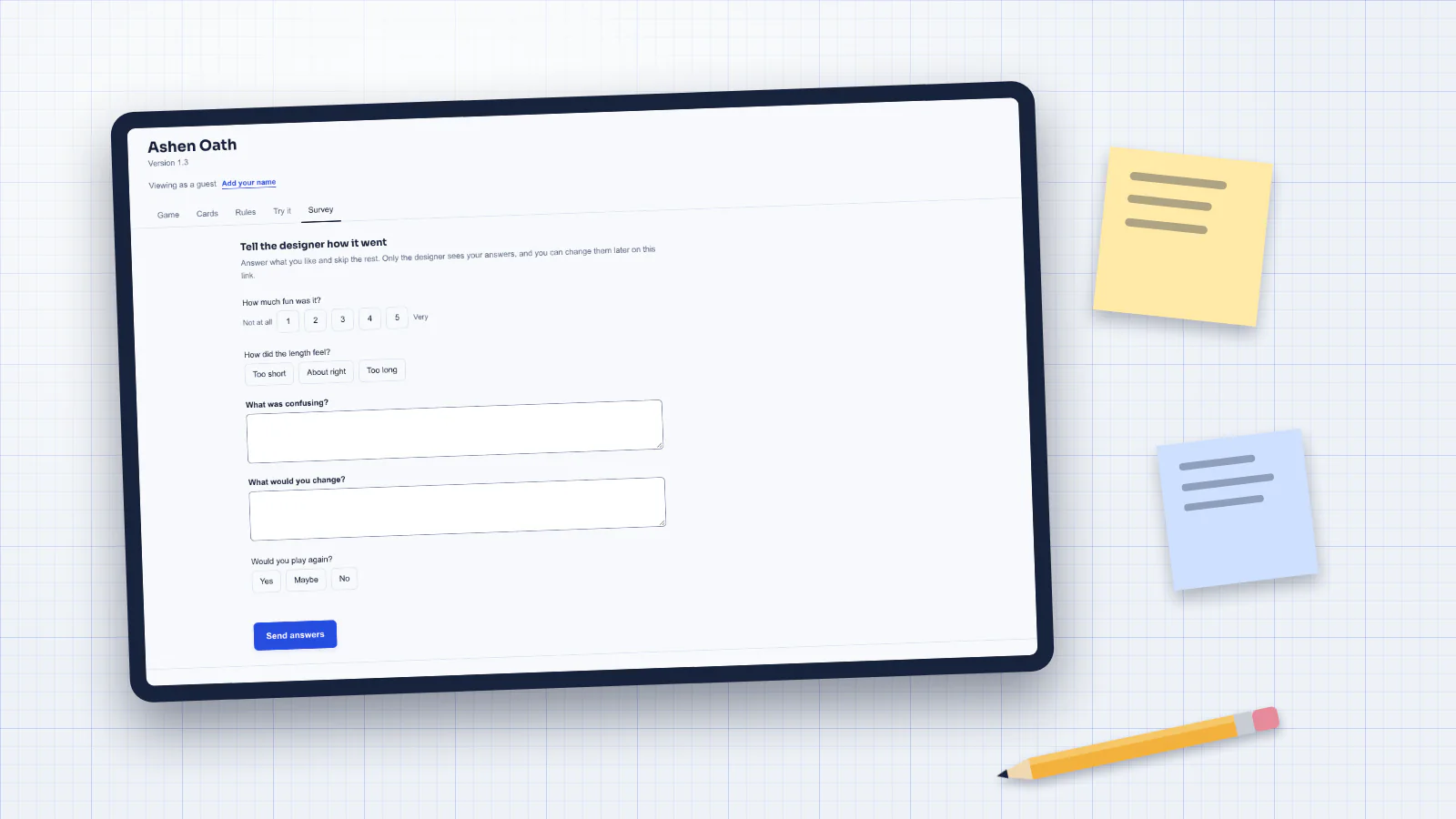
These five are where Decklab AI's playtest links start, and the free feedback form below prints them.
Ask about moments
Specific moments are easier to remember than overall impressions:
- What was the most interesting decision you made?
- When were you waiting with nothing to do?
- Which card did you most want to draw?
- Was there a turn where you felt you had no good choice?
Pick the two or three that fit what you're testing this round. A different focus each round keeps the survey short.
Keep it short
Five questions get thoughtful answers; fifteen get "fine, fine, fine". If you need to know more, ask different questions next round.
Ask at the right time
Straight after the game, before the table starts discussing it. Once one confident player says the game was too long, everyone agrees. Hand out the form, or send the link, while the box is still open.
Collect answers you can compare
Answers on scraps of paper are hard to add up. Two ways to keep them together:
- On paper: the free playtest feedback form prints your questions, one or two to a page, with room to write.
Playtest feedback and log sheets
Print a playtest feedback form for your testers and a log sheet for each session: edit the questions and fields, add your game’s name and version, and download a PDF on Letter or A4, one or two to a page. Free, in your browser, with no sign-up.
- Online: a playtest link asks the survey at the end, and the Feedback page sums it up: each rating's average, each choice's counts, every written answer. With Pro, you can write your own questions.
Ask about cards where they are
The most useful card feedback is attached to the card. On a playtest link, players open a card and react: Too strong, Too weak, Confusing or Love it, with a comment if they want. On the Feedback page, a card three people called too strong is at the top.