
Dice and Card Odds for Game Designers: 3d6, Advantage, Exploding Dice and Opening Hands
How likely is a 7 on 2d6? How much does advantage really help? Will your opening hand have the card it needs? The odds every designer should check, with exact figures and a free calculator.
· 5 min read
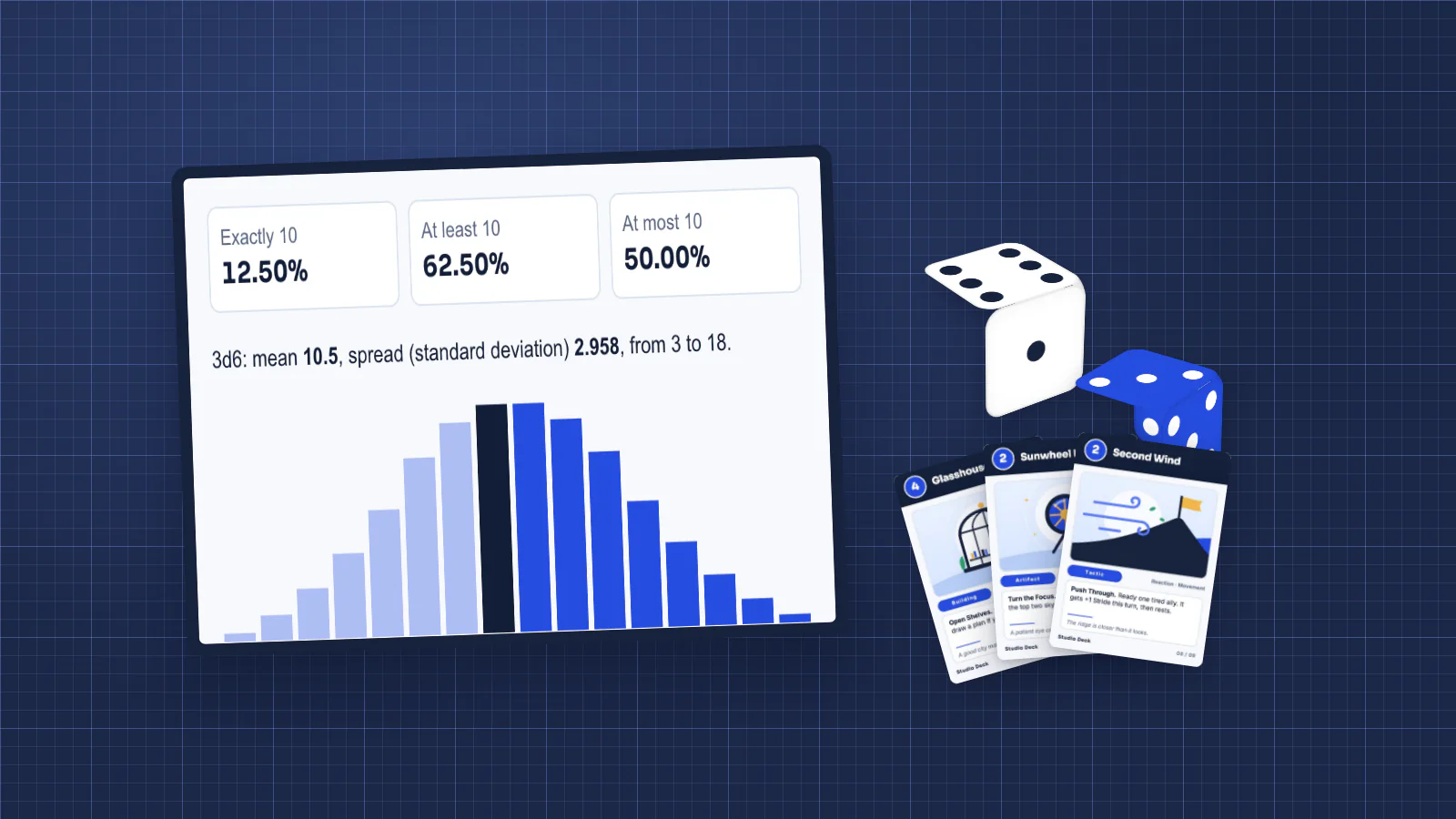
In this post
Every game with dice or a deck makes promises about luck. "You'll usually hit on a 4+." "Most opening hands have a resource." When the real odds don't match the promise, playtesters feel it before anyone can say why: the game feels swingy, or flat, or unfair.
You don't need to be good at maths to check. You need the exact figures, and a sense of which ones matter. Here are the ones designers ask about most.
Dice and card odds calculator
Work out the odds of any dice roll, such as 3d6, 4d6 drop lowest, advantage, exploding dice or a pool of successes, and of drawing the cards you need from a deck, exactly. Free, in your browser, with no sign-up.
2d6: the bell curve everyone uses
Two six-sided dice have 36 ways to land, and six of them make 7, so a 7 comes up 1 time in 6. A 2 or a 12 comes up 1 time in 36.
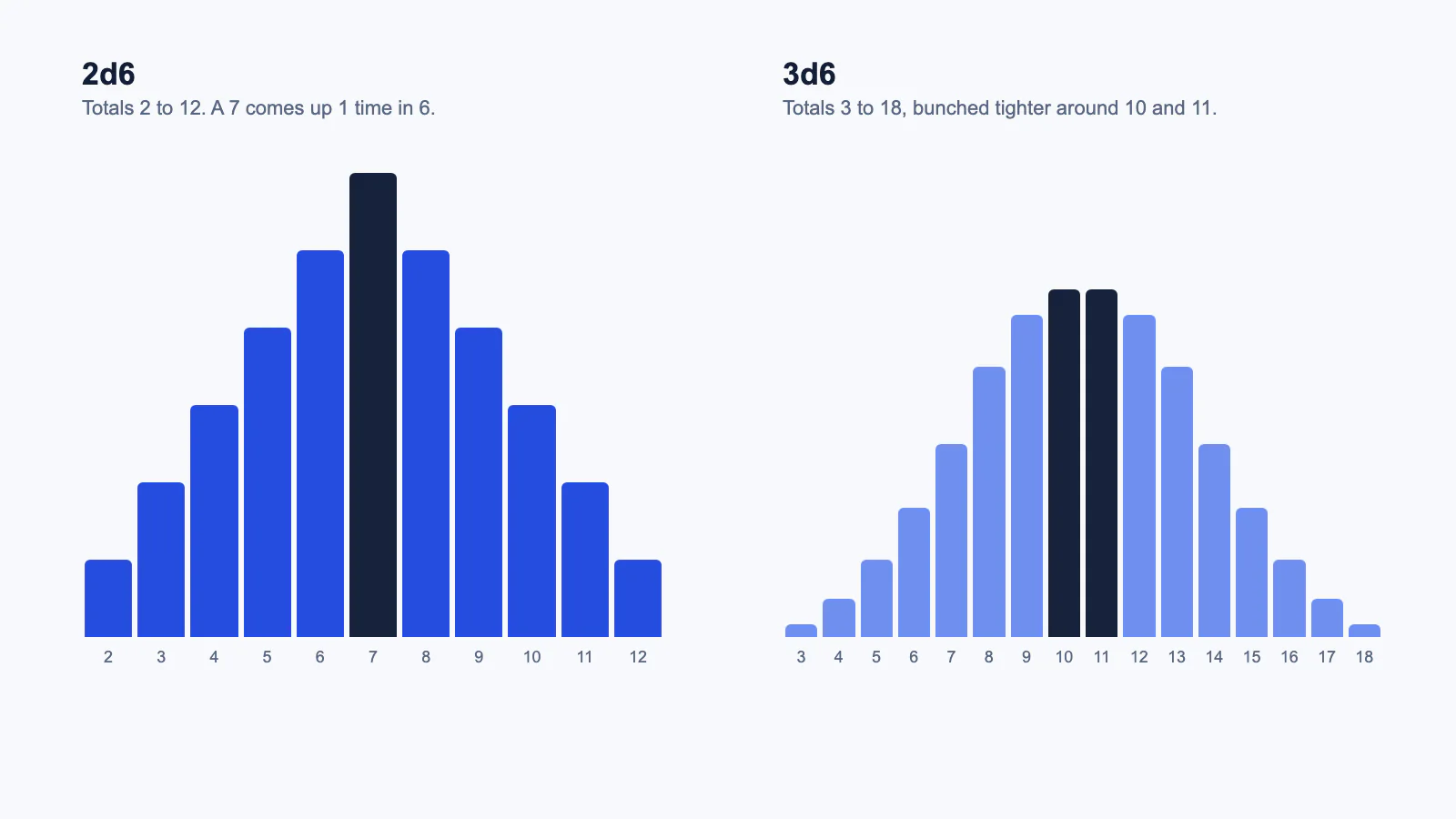
That curve is why 2d6 feels predictable: results bunch in the middle. If a 2d6 roll decides something important, the middle numbers will decide it most of the time. Put your rare effects on 2, 3, 11 and 12; put your everyday ones on 6, 7 and 8. See the full table on the 2d6 probability page.
3d6: tighter still
Three dice average 10.5 with a spread (standard deviation) of about 3: two thirds of rolls land between 8 and 13. Compared with a single d20, where every number is as likely as any other, 3d6 rewards a character's skill more and luck less. The 3d6 table shows each total.
4d6 drop lowest
The classic way to roll ability scores: roll four dice and keep the best three. The average rises from 10.5 to about 12.24, and very low scores almost disappear. Type 4d6kh3 ("keep highest 3") into the calculator, or see the table.
Advantage: worth more than you'd think
Rolling two d20s and keeping the higher is roughly a +3 to +5 bonus, but it isn't flat. Needing a 15 or more:
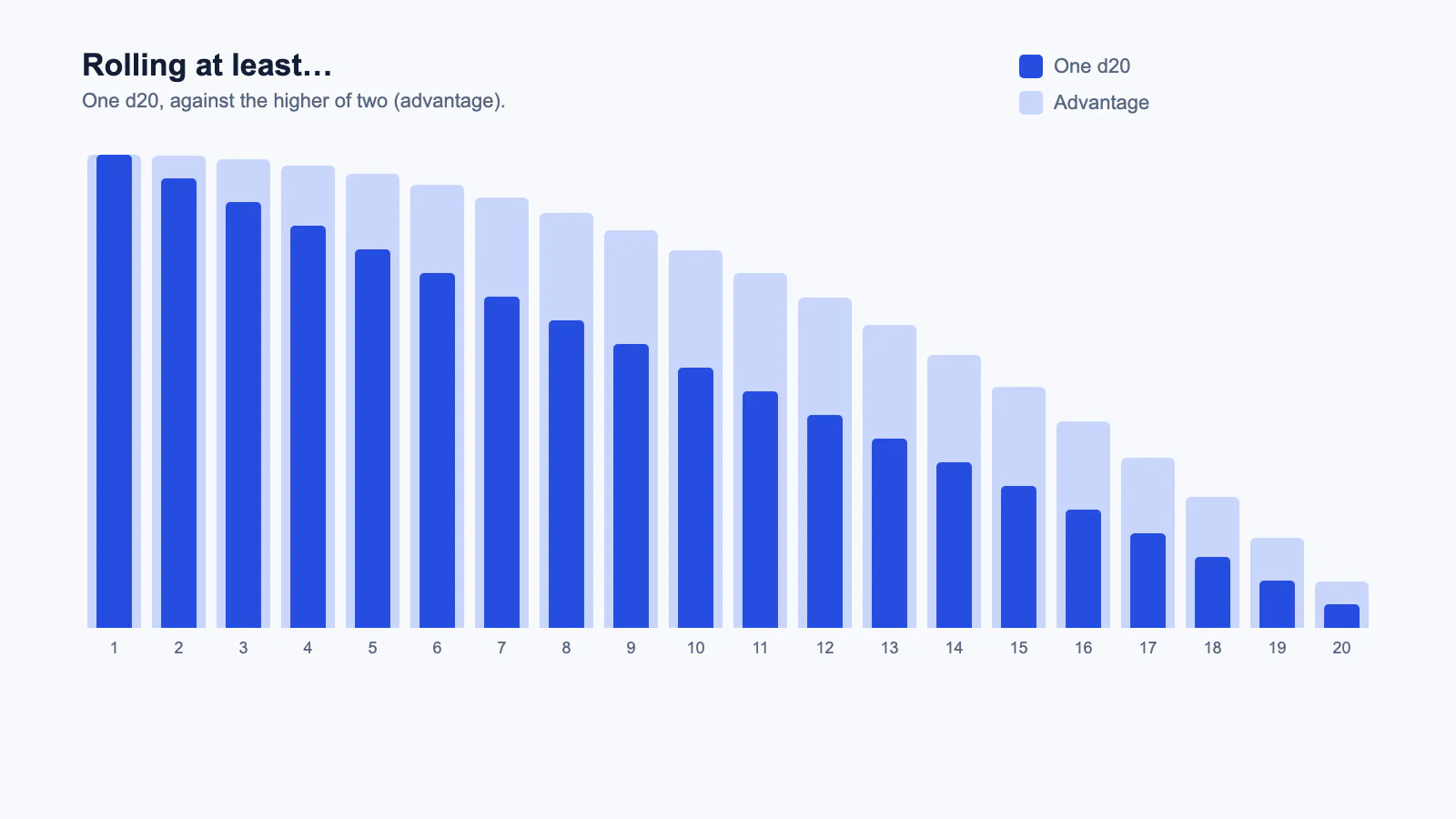
- One d20: 6 in 20, or 30%.
- Two d20s, keep the higher (
2d20kh1): 51%.
Advantage helps most in the middle of the range and least at the extremes. If your game hands out advantage freely, check it against your target numbers. The d20 advantage page has both advantage and disadvantage.
Dice pools: counting successes
Many games roll a handful of dice and count those that hit a target. Six d6s, counting 5s and 6s (6d6>=5), gives at least two successes about 65% of the time. Adding one die to a pool changes the odds more than you'd guess, so check each step of your pool sizes, not just the biggest.
Exploding dice
An exploding d6 (d6!) rolls again on a 6 and adds the result. The calculator caps it at three explosions, which covers all but a sliver of the probability. Exploding dice give a long tail of big results: great for drama, but check that your best results aren't game-breaking when they happen.
Card draws: will the hand have what it needs?
Drawing cards without putting them back follows the hypergeometric distribution. You don't need the name, only four numbers: the deck size, how many cards count, how many you draw, and how many you need.
A 40-card deck with 17 resources, drawing 7: the chance of at least one resource is 98.7%. Drop to 14 resources and it's still high, but the chance of at least two falls faster. The calculator's mulligan option shows what happens if a player can draw a fresh hand once when the first misses. Try it on the 5-card hand page.
::callout[Check the miss, not just the hit. "98% of hands have a resource" means about one game in fifty starts with a dead hand. Is that acceptable for your game? If not, add a mulligan rule or more resources.
For a whole deck, the free cost curve tool works out opening-hand odds straight from your card list, with its cost curve and the cards off the curve. See Make a Cost Curve for Your Card Game.]{tone=tip}
How to use the numbers
- Write down the promise. "A basic attack hits about half the time."
- Type the roll and the target. See the real figure.
- Adjust, then playtest. The numbers tell you what will happen over many games. Playtests tell you how it feels in one.
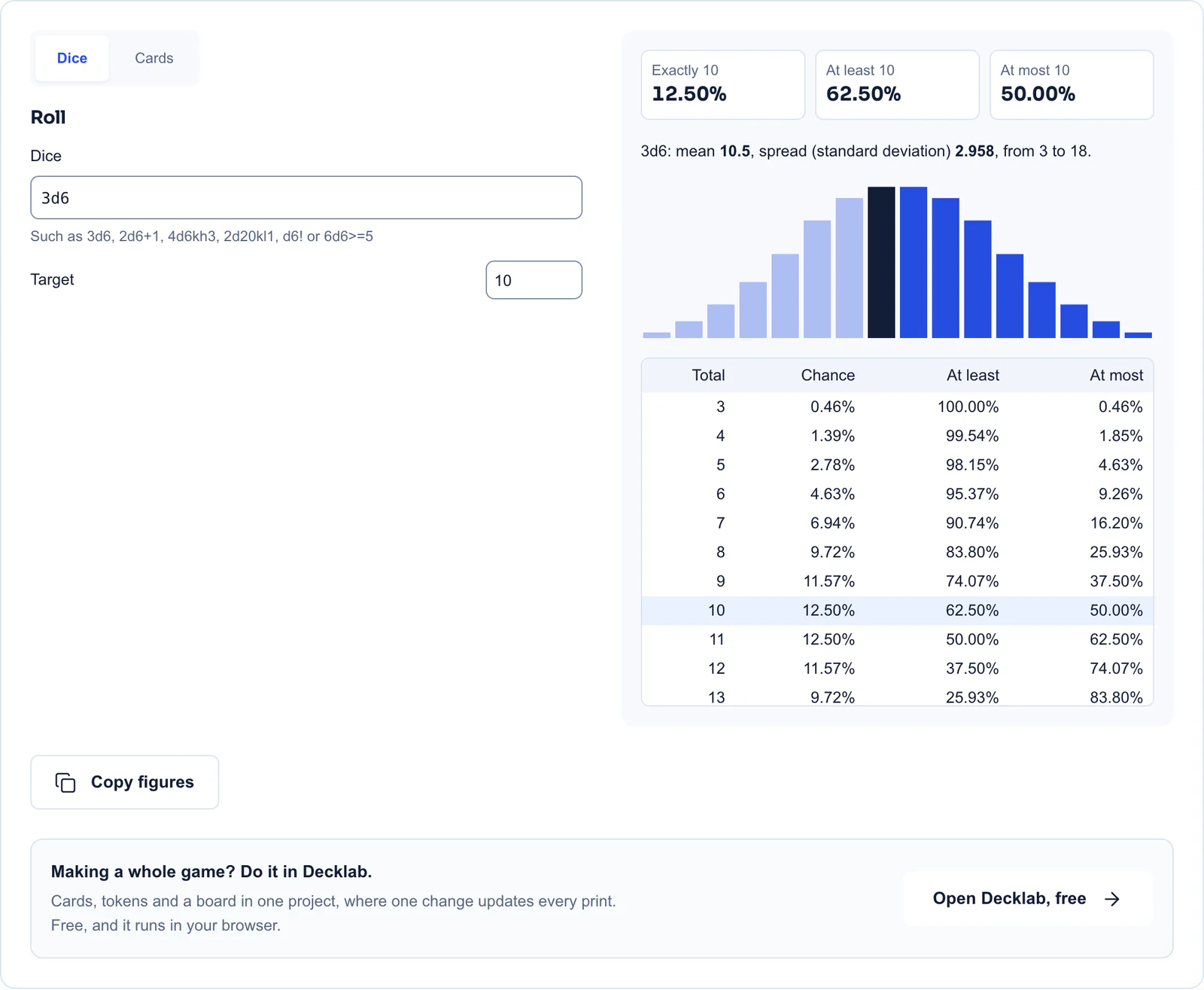
The calculator's figures are exact: every way the dice can land is counted, and card draws use exact counts. Copy the results as text to paste into your design notes.
Once the numbers work, you'll need the dice. The printable dice maker makes custom d4s to d20s to cut and fold, or stickers for blank dice.